
Every Sage chat channel runs in one of three authority modes. The mode determines what Sage is allowed to change, not just what it can see.

The modes

The New AI Chat dialog labels these Conversation, Supervised, and Autonomous; Autonomous is auto. Set the mode when you create the channel, or switch it live with /mode (no argument reports the current mode).

Assisted mode is not a fourth mode

The assisted product covers conversation and supervised together. It is not a separately selectable runtime mode: conversation observes and answers without guarded activity, and supervised executes only the exact guarded action you accept.

Supervised approvals

In supervised mode every guarded action (issuing a command, executing a capability, creating a payload, adding a credential) pauses as a native Mythic approval request before it runs. This is human-in-the-loop (HITL) execution: Sage proposes, and you decide. Approval is default-deny, and the card gives you three responses: Accept approves exactly the prepared action, Reject skips it, and Respond answers with your own instructions, which Sage incorporates before acting again. Read-only tools never prompt.
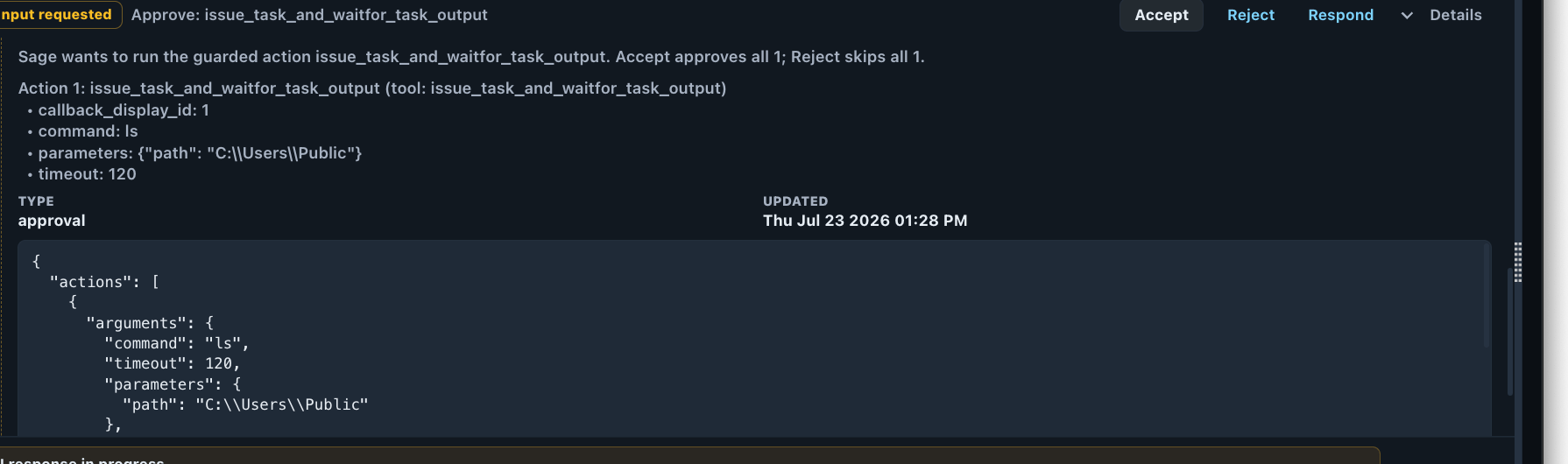
A Mythic chat approval card: Sage proposes issuing a task on callback 1, with Accept, Reject, and Respond controls

A guarded action waiting on your decision in a supervised channel (Sage beta, captured July 2026).

Guarded tools are scope-preflighted: each requires a Mythic bot-token scope (callback.write, payload.write, credential.write, file.write), and a tool whose scope your channel token lacks is disabled up front rather than failing mid-run.

Objective-led supervised runs

A supervised channel can also pursue a stated objective across turns. Sage still proposes one guarded action at a time, and each runs only after you approve its card; objectives and evidence survive approvals, rejections, and specialist handbacks. When BloodHound has data and the request is about an attack path, Sage queries the graph for a path to the objective before tasking. Turning on Autonomous Solve in the channel configuration forces this deterministic multi-hop solving for the session; completion still requires objective evidence. See Chat channel configuration.

Auto is experimental and GOAD-validated only

Auto pursues an explicitly bound objective without approval of each action. Its validation is the GOAD lab environment only. That does not establish reliability or generality for other environments, and it is not a production endorsement. Sage plans from the graph and callbacks in front of it, not from benchmark-specific strategies baked into the product. Treat auto as a lab capability until a release says otherwise.