
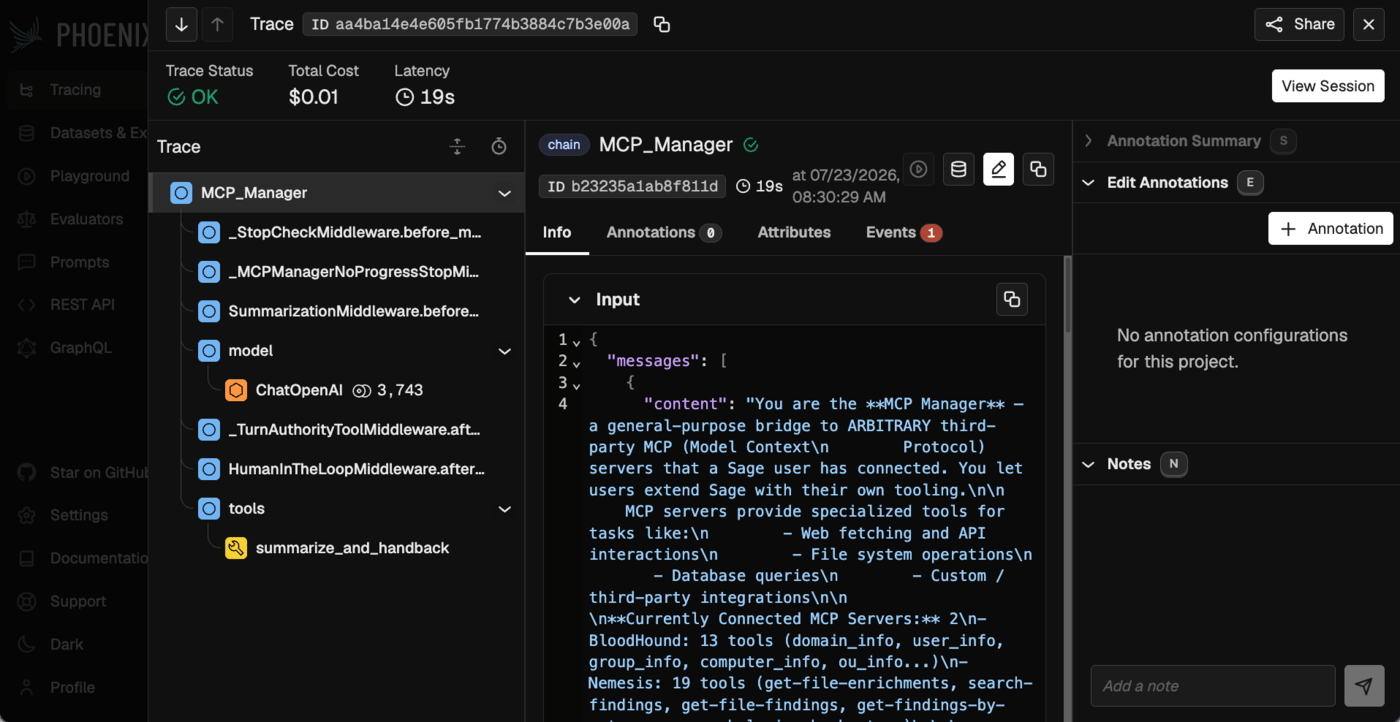
A Phoenix trace of one MCP Manager turn: the span tree on the left (middleware, the model call with its token count, and the tool call), and the selected span's input on the right.
http://localhost:6006 by default. Sage does not configure
Phoenix authentication or its bind address, so Phoenix’s own defaults apply. Traces contain prompts
and tool output; from another machine, reach the UI through an SSH tunnel rather than by exposing
the port.
Two execution paths, two span trees
Sage’s two execution paths produce different traces. Knowing which one you ran is the difference between reading a trace and misreading it.
A run with no LLM spans is not necessarily a broken trace. The kernel’s policy backend can run
symbolically or hybridly without consulting a model; when it does, the run legitimately contains
zero model spans. Compare against the run’s own
model_calls in its runtime telemetry rather than
assuming loss.
Every seam.policy_select span carries the decision it produced (disposition, rationale, and
whether the model responded), so a run that stopped because the model was unreachable says so in
the trace instead of only in a failed leaf span.
Working with traces
Traces persist in.phoenix/phoenix.db. Copy them WAL-inclusively: copying phoenix.db without
its -wal sidecar silently drops everything not yet checkpointed.
If you work from a Sage source checkout, a helper script checks whether a run is traced at all,
rather than you reading span counts by eye. It is not part of a Mythic install:
TRACED, PARTIAL, UNTRACED, or EMPTY, and exits non-zero on anything but
TRACED.
Known limits
- Kernel spans cover the controller’s own steps; a Mythic task issue and its wait are traced as
part of the
executeseam rather than as separate spans. - Span attribute values are capped (128 KB), so a very large prompt or tool output is truncated in the trace, not dropped.
- Set
SAGE_KERNEL_TRACING=0to disable kernel spans; LangChain instrumentation is unaffected by it.